
In a world that often feels like it is moving too fast, our homes have become our most vital sanctuaries. The shift towards “considered living” is more than just a passing aesthetic trend. It is a fundamental move away from the “fast furniture” culture that has seen millions of tonnes of homewares end up in landfills every year. Across Europe, roughly 9 million tonnes of furniture are discarded annually. The UK contributes a significant portion to this environmental burden.
At Earthly Treasures, we believe that your furniture should have a story of provenance. This guide is your ultimate resource for navigating the complex landscape of sustainable home furnishing materials in 2026. It will help you to build a home that prioritises people, planet, and exquisite British craftsmanship.
At a Glance: Sustainable Furnishing in 2026
If you are looking for a quick summary of what to consider and look for when furnishing your home more mindfully with sustainable pieces, here are the key pillars of this guide:
- The Lifecycle Assessment (LCA) Mindset: Why we look at a product’s entire journey, from raw extraction to its final return to the earth.
- Natural Powerhouses: A deep dive into British hardwoods, reclaimed timber, rapidly renewable bamboo, and regenerative cork.
- The Textile Revolution: Why linen and industrial hemp are the favourites for low-water, carbon-negative soft furnishings.
- Bio-Design & Innovation: Exploring the 2026 world of furniture grown from fungi (mycelium) and seaweed-based comfort foams.
- Healthy Interiors: Understanding why low-VOC furniture finishes and non-toxic certifications are non-negotiable for wellbeing.
- The 2026 Aesthetic: Why “Cloud Dancer” white and earthy, mineral palettes are defining the new era of Warm Minimalism.
Already purchased a sustainable furniture piece and wondering how to maintain it? You can read our guide on low VOC and natural furniture finishes here.
The Selection of Sustainable Home Furnishing Materials
To build an ethical interior, we must look beyond the product labels and adopt a Life Cycle Assessment (LCA) approach. An LCA is a scientific methodology that evaluates the total environmental impact of a product from “cradle to grave”. This process includes raw material extraction, production energy, transport, the use phase, and what happens to the piece when it is no longer needed.
The importance of the design phase is paramount. Research indicates that up to 80% of a product’s environmental impact is determined during the initial concept stage. The pre-production stage, which encompasses raw materials and initial processing, accounts for an average of 76% of a furniture item’s total carbon footprint. By choosing materials with a low baseline carbon output, you are making the most impactful decision possible for your home’s ecological legacy.
Prioritising Indoor Air Quality and Chemical Safety
A major focus for the premium market in 2026 is ensuring that a home is a healthy environment. Non-toxic home decor is no longer a niche requirement; it is a standard. Many traditional furnishings use glues and varnishes that release Volatile Organic Compounds (VOCs), which can linger for years and affect respiratory health. By prioritising low-VOC furniture finishes and certified materials, you ensure your sanctuary supports your long-term wellbeing.
If you’re looking how to detect low-VOC furniture finishes and choose non-toxic options, read our helpful guide here.
Top Sustainable Materials for Furniture and Decor
The “rigid” elements of your home—the frames, surfaces, and structures—form the backbone of your interior. In 2026, the focus has shifted toward circular furniture design, where materials are chosen for their ability to be reused, repaired, or safely returned to the earth.
1. Reclaimed Timber: The Circular Champion
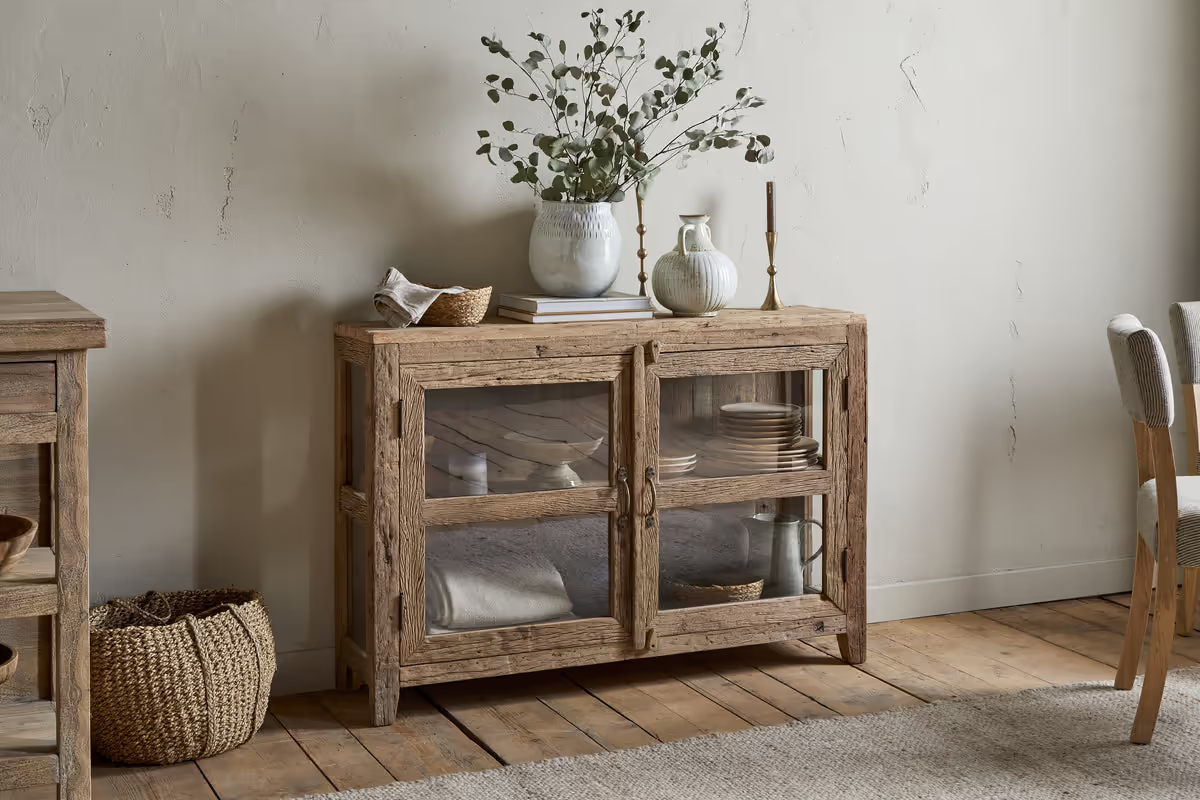
If the goal is to minimise environmental impact, reclaimed wood is the undisputed winner. Sourced from old barns, factories, or deconstructed historical buildings, this timber prevents waste from entering landfills and eliminates the need for virgin timber harvesting. Utilising reclaimed wood can reduce carbon emissions by up to 75% compared to new timber.
Beyond its ethical profile, it offers a “tactile authenticity” that new wood cannot match. Because this wood often comes from old-growth forests that are centuries old, it is significantly denser and more stable than modern commercial timber. This makes it resistant to warping and cracking.
Certifications to look for: Look specifically for the FSC Recycled label. This provides third-party verification that the wood is genuinely 100% reclaimed. Additionally, check for finishes that use natural oils or waxes rather than heavy chemical finishes to maintain the wood’s ability to “breathe.”
2. FSC-Certified Hardwoods and British Forestry
Wood remains the cornerstone of premium interiors, but its source determines whether it is a climate ally or a driver of deforestation. The Forest Stewardship Council (FSC) and the Programme for the Endorsement of Forest Certification (PEFC) are the global standards for responsible forest management.
In the UK, leading figures like the award-winning craftsman, Sebastian Cox advocate for the use of British hardwoods and traditionally coppiced wood, which encourages biodiversity in local woodlands. Coppicing allows trees to grow faster and lock away more carbon while allowing light to reach the forest floor. Over 77% of UK consumers recognise the FSC “tree tick” logo, making FSC-certified wood furniture a non-negotiable for the premium market.
Certifications to look for: Always verify the brand’s specific FSC or PEFC license number. High-authority makers like Benchmark Furniture lead the industry by providing transparent sustainability reports that trace timber back to its origin.
3. Bamboo: The Powerhouse of Rapid Renewability
Bamboo is a rapidly renewable grass that reaches structural maturity in just three to five years. Hardwoods, however, can take decades. It regrows from the same root system after harvesting, meaning it acts as a permanent carbon reservoir. Research indicates that a hectare of well-managed Moso bamboo can take in up to 5.5 tonnes of carbon annually.
However, its sustainability depends heavily on the adhesives used. For a truly healthy home, it is essential to prioritise bamboo furniture bonded with “no-added-urea-formaldehyde” (NAUF) adhesives to maintain high indoor air quality.
Certifications to look for: Look for GREENGUARD Gold certification. This ensures the product has been tested for over 360 VOCs and meets the strictest emission levels for home environments.
4. Rattan and Cane: Guardians of the Tropical Forest
Rattan is a climbing vine native to Southeast Asian forests. Because it must climb established trees to reach sunlight, its commercial value provides a powerful economic incentive for local communities to keep rainforests standing rather than clearing them for agriculture. It grows at an incredibly rapid rate of 2 to 3 centimetres per day and is entirely biodegradable at the end of its life, provided it is not treated with toxic synthetic lacquers.
Certifications to look for: In the UK, look for rattan brands that adhere to the Ethical Trading Initiative (ETI) or specific legal harvesting standards like SVLK to ensure craftspeople are paid fair wages.
5. Cork: Regenerative Bark and Acoustic Calm
Cork is harvested by stripping the outer bark of the Cork Oak tree, a process that does not harm the tree and allows it to live for over 200 years. A harvested tree actually absorbs up to five times more CO2 than an unharvested one as it works to regrow its “skin”. It is naturally antimicrobial, moisture-resistant, and provides excellent acoustic insulation, making it a perfect choice for flooring and furniture in busy households.
Certifications to look for: Like timber, cork should ideally be FSC-certified. This guarantees that the cork stands are managed to protect the unique biodiversity of the Mediterranean “dehesa” ecosystems.
6. Natural Stone versus Engineered Counterparts
In 2026, the luxury market is shifting back to natural stones like granite, marble, and quartzite. Natural stone is quarried directly from the earth and requires minimal processing compared to its engineered counterparts. Engineered stone (Quartz) is a composite held together by petroleum-based resins and has a significantly higher global warming potential. Furthermore, recent health concerns regarding high-silica dust during the manufacturing of engineered stone have led many designers to favour natural stone as the safer choice.
Certifications to look for: The NSF/ANSI 373 Sustainable Production of Natural Dimension Stone standard is the one to watch. It evaluates quarries and fabricators on water usage, site management, and human health.
7. Recycled Metals and Plastics
Recycling aluminium for furniture frames reduces energy consumption by a staggering 95% compared to virgin aluminium production. Similarly, recycled PET (rPET), often derived from ocean-bound plastic, uses 75% less energy and 84% less water than virgin polyester. These materials are ideal for high-traffic or outdoor areas where extreme durability is a priority.
Certifications to look for: The Global Recycled Standard (GRS) verifies the recycled content in products and tracks it from the recycler to the final piece, ensuring strict social and environmental requirements are met.
Sustainable Fabrics for Upholstery and Textiles
The “soft” side of your home has a massive impact on both the planet and your personal wellbeing. Farming and factory energy are the biggest factors in a textile’s environmental footprint.
1. Linen and the Advantages of Flax
While we love organic cotton for its softness, linen (derived from the flax plant) is the superior choice for sustainable materials for home furnishings. Flax is a resilient crop that predominantly relies on natural rainfall, requiring roughly six times less water than cotton (approx. 500 litres vs 10,000 litres per kg of fibre). Linen is naturally moth-resistant, stronger than cotton, and actually improves with age, becoming softer with every wash. Flax linen is fantastic for bedding, keeping sleepers cool in the summer and warm in the winter. Linen however, absorbs the humidity in the air, so may not be suitable for curtains for damp environments due to fabric relaxing.
Certifications to look for: Look for the European Flax® or Masters of Linen™ labels. These guarantee that the flax was grown in Western Europe under strict environmental standards and ensure full traceability from field to fabric.
2. Organic Cotton: A Better Foundation
Organic cotton is grown without synthetic pesticides or GMOs, which promotes healthy soil and reduces chemical exposure for workers. While it still requires more water than linen or hemp, it is a vast improvement over conventional cotton, which is often termed the “water beast” of the textile world.
Certifications to look for: Always look for the GOTS (Global Organic Textile Standard) label. For an extra layer of assurance regarding chemical safety, the OEKO-TEX® Standard 100 label ensures the textile has been tested for over 1,000 harmful substances.
3. Industrial Hemp: The Ultimate Carbon Sink
Industrial hemp is arguably the most sustainable fibre on the planet. It can absorb up to 22 tonnes of CO2 per hectare, capturing carbon twice as effectively as many forests. Hemp requires virtually no pesticides, uses 80% less water than cotton, and produces a fabric that is four times more durable. It is a breathable, non-toxic choice for sofas and curtains that helps your home actively breathe.
Certifications to look for: As with cotton, the GOTS label is the gold standard for hemp, ensuring environmentally and socially responsible processing.
4. Wool: The Paradigm of Longevity
Wool is a renewable, biodegradable fibre with incredible longevity. It is naturally flame-retardant, meaning wool sofas can often avoid the harsh chemical fire treatments required for synthetic fabrics. To lower the carbon footprint of sheep farming, look for “mechanically recycled” wool, such as MWool®, which reduces the carbon impact by up to 90%.
Certifications to look for: The Responsible Wool Standard (RWS) provides a benchmark for animal welfare and land management. It ensures that wool comes from farms that ban painful practices like mulesing and have a progressive approach to protecting soil health.
Bio-Design and the Revolution of 2026
The future of luxury furniture isn’t just about what we take from the earth, but what we can grow. In eco-friendly interior design 2026, “Material Alchemy” is turning biology into functional art.
Mycelium as a Structural Material
Mycelium—the root network of mushrooms—is being grown on agricultural waste (like hemp husks) to create strong, lightweight furniture cores. Dutch brand Aifunghi (led by Moooi alumni) recently debuted furniture that is as strong as concrete but entirely compostable in your garden at the end of its life. This represents the pinnacle of circular design, where a piece of furniture can literally return to the soil to nourish new life.
Seaweed-Based Fibres and Algae Foams
Some seaweed can grow up to 50cm per day without requiring farmland or freshwater resources as it is grown in the sea. Innovations like SeaCell™ are blending marine algae with wood cellulose through a closed-loop process to create fibres that are 50% more breathable than cotton and rich in minerals that soothe sensitive skin. These textiles are appearing in luxury bedding, offering a regenerative alternative to land-based crops.
Traditional furniture cushions rely on petroleum-based polyurethane. In 2026, brands like Agoprene are replacing these with algae-based comfort foams. Derived from waste marine kelp, these foams are naturally flame-retardant to the highest UK safety standards and will safely decompose in soil within months.
Interior Design Trends and Aesthetics for 2026
Sustainability in 2026 is moving away from “cold minimalism” toward a style that prioritises comfort, tactility, and emotional wellbeing. This movement, often called “Warm Minimalism”, celebrates the relationship between technology and nature.
The Rise of Cloud Dancer White
Pantone’s 2026 Colour of the Year, Cloud Dancer, is a soft, “billowy” white that provides a visual reset. It has gentle, warm undertones that highlight the rich grains of natural wood and stone, avoiding the clinical coldness of traditional stark whites. This shade acts as the perfect blank canvas, allowing textured materials like bouclé and raw linen to take centre stage.
Earthy Palettes and Natural Tones
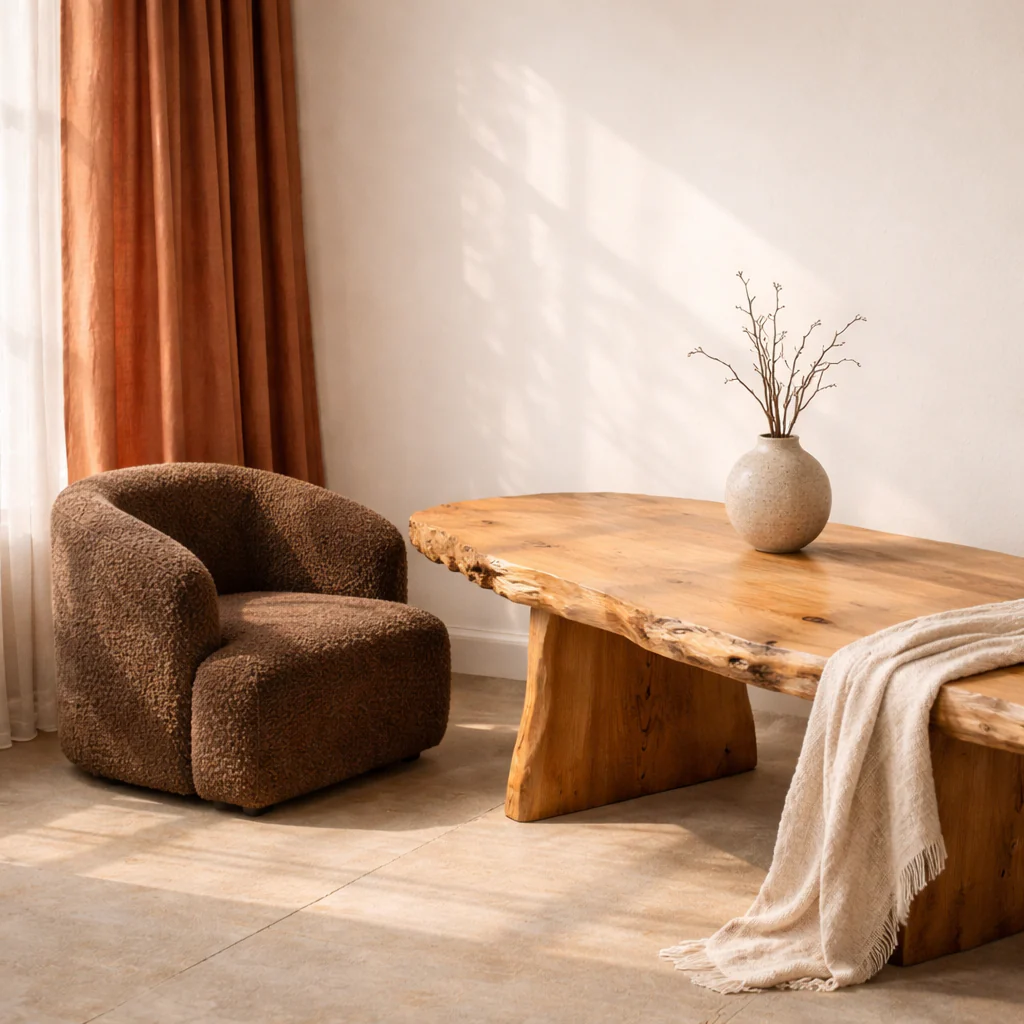
Expect to see “colour drenching” in deep olives and sage greens, aubergine, terracotta, clay reds, and rich chocolate browns. These tones are psychologically grounding and help to blur the lines between our indoor and outdoor spaces. In 2026, the home is treated as an extension of the natural world, using mineral pigments and lime-wash finishes to create a breathable, organic atmosphere.
Invisible Technology and Smart Comfort
In 2026, smart homes are about responsive comfort that doesn’t scream “tech.” Expect to see furniture with hidden wireless charging pads built directly into stone tops or “listening chairs” designed for vinyl records. Technology is learning to “feel,” with sensors hidden within materials to monitor air quality or adjust lighting warmth in sync with our circadian rhythms.
Identifying Genuine Transparency and Avoiding Greenwashing
As sustainability becomes a premium status symbol, some brands use vague language to hide a lack of real action. Beware of labels that just say “Eco” or “Natural” without providing data or further transparency. Genuine sustainable furniture companies will name specific wood species, provide clear certification license numbers (like an FSC license), and offer detailed material breakdowns for every component.
A powerful tool emerging in 2026 is the Digital Product Passport (DPP). This is a digital record scannable via QR code that stores verified information about a product’s origin, environmental footprint, and repair instructions. This tool is becoming the baseline for transparency in the premium market, ensuring that traceability is as much a part of luxury as the design itself and could soon become the requirement for household textiles.
Summary Checklist for Eco-Conscious Choices
To help you make the best choice for your home, use this quick reference for the most common certifications:
| Certification | Focus Area | Why it Matters |
| FSC / PEFC | Timber Sourcing | Guarantees wood comes from responsibly managed forests. |
| GOTS | Organic Textiles | The gold standard for organic fibres and ethical labour. |
| Cradle to Cradle | Circularity | Assesses material health and full recyclability. |
| OEKO-TEX | Chemical Safety | Ensures the product is free from harmful substances. |
| Greenguard Gold | Air Quality | Tests for over 360 VOCs to ensure clean indoor air. |
Frequently Asked Questions
What are VOCs and why should I care about them?
VOCs (Volatile Organic Compounds) are chemicals found in many traditional furniture finishes, glues, and foams. They “off-gas” into your home, potentially causing headaches and respiratory issues. Choosing low-VOC furniture finishes or GREENGUARD Gold certified items ensures your indoor air remains clean.
Is bamboo furniture really better than solid oak?
Not always. While bamboo grows faster, its sustainability depends on the adhesives used to bind it. A solid oak piece from a UK maker using FSC-certified wood can be just as sustainable if it is built to last for generations.
What is the most eco-friendly fabric for a sofa?
Industrial hemp and linen are the frontrunners. Both require significantly less water than cotton and are more durable, meaning they will last for decades rather than years.
Can I recycle my old furniture?
Currently, only a tiny fraction (0.1%) of discarded furniture is recycled into new furniture. The best approach is to choose circular furniture design—pieces designed for disassembly, repair, or composting (like mycelium and untreated rattan).
Next Steps: Curate with Intention
The most sustainable home is one that is built to last. We encourage a “One-Trend Upgrade” approach: investing in a single, high-quality, beautifully crafted piece that will last decades rather than a room full of disposable décor. By choosing materials like industrial hemp, reclaimed wood, and mycelium, you aren’t just buying furniture; you are investing in a circular future. A home filled with Earth’s Treasures is one that tells a story of craftsmanship, respect for the planet, and a life lived with consideration.